spatially convergent partial cross mapping
Usage
# S4 method for class 'sf'
scpcm(
  data,
  cause,
  effect,
  conds,
  libsizes = NULL,
  E = 3,
  k = E + 2,
  tau = 1,
  style = 1,
  stack = FALSE,
  lib = NULL,
  pred = NULL,
  dist.metric = "L2",
  dist.average = TRUE,
  theta = 1,
  algorithm = "simplex",
  threads = detectThreads(),
  detrend = TRUE,
  parallel.level = "low",
  bidirectional = TRUE,
  progressbar = TRUE,
  cumulate = FALSE,
  nb = NULL
)

# S4 method for class 'SpatRaster'
scpcm(
  data,
  cause,
  effect,
  conds,
  libsizes = NULL,
  E = 3,
  k = E + 2,
  tau = 1,
  style = 1,
  stack = FALSE,
  lib = NULL,
  pred = NULL,
  dist.metric = "L2",
  dist.average = TRUE,
  theta = 1,
  algorithm = "simplex",
  threads = detectThreads(),
  detrend = TRUE,
  parallel.level = "low",
  bidirectional = TRUE,
  progressbar = TRUE,
  cumulate = FALSE,
  grid.coord = TRUE,
  embed.direction = 0,
  win.ratio = 0
)
Arguments
- data
observation data.
- cause
name of causal variable.
- effect
name of effect variable.
- conds
name of conditioning variables.
- libsizes
(optional) number of spatial units used (input needed:
vector- spatial vector,matrix- spatial raster).- E
(optional) embedding dimensions.
- k
(optional) number of nearest neighbors.
- tau
(optional) step of spatial lags.
- style
(optional) embedding style (
0includes current state,1excludes it).- stack
(optional) whether to stack embeddings.
- lib
(optional) libraries indices (input requirement same as
libsizes).- pred
(optional) predictions indices (input requirement same as
libsizes).- dist.metric
(optional) distance metric (
L1: Manhattan,L2: Euclidean).- dist.average
(optional) whether to average distance.
- theta
(optional) weighting parameter for distances, useful when
algorithmissmap.- algorithm
(optional) prediction algorithm.
- threads
(optional) number of threads to use.
- detrend
(optional) whether to remove the linear trend.
- parallel.level
(optional) level of parallelism,
loworhigh.- bidirectional
(optional) whether to examine bidirectional causality.
- progressbar
(optional) whether to show the progress bar.
- cumulate
(optional) serial or cumulative computation of partial cross mapping.
- nb
(optional) neighbours list.
- grid.coord
(optional) whether to detrend using cell center coordinates (
TRUE) or row/column numbers (FALSE).- embed.direction
(optional) direction selector for embeddings (
0returns all directions,1-8correspond to NW, N, NE, W, E, SW, S, SE).- win.ratio
(optional) ratio of sliding window scale to speed up state-space predictions.
Value
A list
pxmappartial cross mapping results
xmapcross mapping results
varnamenames of causal, effect and conditioning variables
bidirectionalwhether to examine bidirectional causality
Examples
columbus = sf::read_sf(system.file("case/columbus.gpkg",package="spEDM"))
# \donttest{
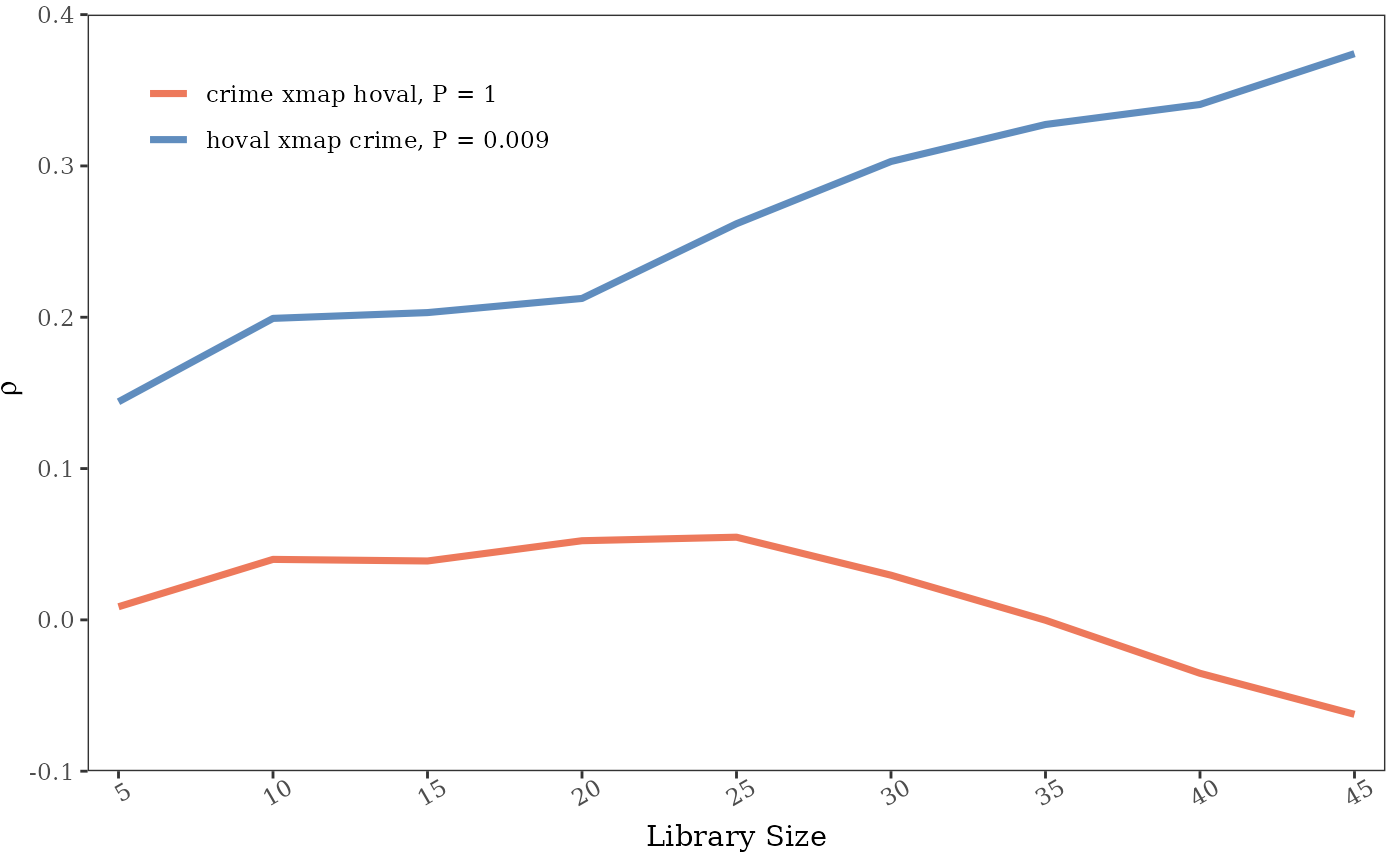
g = spEDM::scpcm(columbus,"hoval","crime","inc",libsizes = seq(5,45,5),E = 6)
#>
Computing: [========================================] 100% (done)
#>
Computing: [========================================] 100% (done)
g
#> --------------------------------------
#> ***partial cross mapping prediction***
#> --------------------------------------
#> libsizes hoval->crime crime->hoval
#> 1 5 0.0086754124 0.1441249
#> 2 10 0.0399772770 0.1992493
#> 3 15 0.0389222644 0.2030752
#> 4 20 0.0523102119 0.2124205
#> 5 25 0.0546388996 0.2618028
#> 6 30 0.0295265815 0.3029333
#> 7 35 -0.0002461041 0.3273864
#> 8 40 -0.0353020518 0.3406083
#> 9 45 -0.0624158975 0.3741926
#>
#> ------------------------------
#> ***cross mapping prediction***
#> ------------------------------
#> libsizes hoval->crime crime->hoval
#> 1 5 0.1253050 0.2568469
#> 2 10 0.1762769 0.3961522
#> 3 15 0.2197481 0.4672470
#> 4 20 0.2324435 0.5144297
#> 5 25 0.2354728 0.5713321
#> 6 30 0.2360934 0.6048914
#> 7 35 0.2412944 0.6253026
#> 8 40 0.2383788 0.6364897
#> 9 45 0.2339483 0.6484721
plot(g,ylimits = c(-0.1,0.4),ybreaks = seq(-0.1,0.4,0.1))
 # }
# }