Spatially Convergent Partial Cross Mapping
Wenbo Lyu
Last
update: 2026-09-10
Last run: 2026-09-10
Source: Last run: 2026-09-10
vignettes/main6_scpcm.Rmd
main6_scpcm.RmdModel principles
The methodological details are pending peer review and will be made available thereafter.
Usage examples
Example of spatial vector data
Load the spEDM package and columbus OH spatial analysis
dataset:
if (!requireNamespace("spEDM")) install.packages("spEDM")
## Loading required namespace: spEDM

columbus = sf::read_sf(system.file("case/columbus.gpkg", package="spEDM"))
columbus
## Simple feature collection with 49 features and 6 fields
## Geometry type: POLYGON
## Dimension:     XY
## Bounding box:  xmin: 5.874907 ymin: 10.78863 xmax: 11.28742 ymax: 14.74245
## Projected CRS: Undefined Cartesian SRS with unknown unit
## # A tibble: 49 × 7
##    hoval   inc  crime  open plumb discbd                        geom
##    <dbl> <dbl>  <dbl> <dbl> <dbl>  <dbl>                   <POLYGON>
##  1  80.5 19.5  15.7   2.85  0.217   5.03 ((8.624129 14.23698, 8.559…
##  2  44.6 21.2  18.8   5.30  0.321   4.27 ((8.25279 14.23694, 8.2827…
##  3  26.4 16.0  30.6   4.53  0.374   3.89 ((8.653305 14.00809, 8.818…
##  4  33.2  4.48 32.4   0.394 1.19    3.7  ((8.459499 13.82035, 8.473…
##  5  23.2 11.3  50.7   0.406 0.625   2.83 ((8.685274 13.63952, 8.677…
##  6  28.8 16.0  26.1   0.563 0.254   3.78 ((9.401384 13.5504, 9.4344…
##  7  75    8.44  0.178 0     2.40    2.74 ((8.037741 13.60752, 8.062…
##  8  37.1 11.3  38.4   3.48  2.74    2.89 ((8.247527 13.58651, 8.279…
##  9  52.6 17.6  30.5   0.527 0.891   3.17 ((9.333297 13.27242, 9.671…
## 10  96.4 13.6  34.0   1.55  0.558   4.33 ((10.08251 13.03377, 10.09…
## # ℹ 39 more rows
We demonstrate how spatial vector data can be used in SCPCM analysis through a causal example examining the influences of the level of burglary incidents in a neighbourhood on house values, with neighbourhood household income included as a conditioning variable.
Determine minimum embedding dimensions:
spEDM::fnn(columbus,"crime",E = 1:10)
## [fnn] Input E values exceeding max embeddable dimension were truncated, and values < 2 were clamped to 2.
## [fnn] Max embedding dimension E_max is auto-computed, with results returned for dimensions 1 through E_max.
## [fnn] Output 'E:i' (where i = 1 to E_max-1) corresponds to the comparison between dimension i and i+1.
##        E:1        E:2        E:3        E:4        E:5        E:6
## 0.79591837 0.53061224 0.63265306 0.51020408 0.12244898 0.04081633
##        E:7        E:8
## 0.00000000 0.00000000
spEDM::fnn(columbus,"hoval",E = 1:10)
## [fnn] Input E values exceeding max embeddable dimension were truncated, and values < 2 were clamped to 2.
## [fnn] Max embedding dimension E_max is auto-computed, with results returned for dimensions 1 through E_max.
## [fnn] Output 'E:i' (where i = 1 to E_max-1) corresponds to the comparison between dimension i and i+1.
##        E:1        E:2        E:3        E:4        E:5        E:6
## 0.85714286 0.77551020 0.51020408 0.61224490 0.22448980 0.08163265
##        E:7        E:8
## 0.00000000 0.00000000
spEDM::fnn(columbus,"inc",E = 1:10)
## [fnn] Input E values exceeding max embeddable dimension were truncated, and values < 2 were clamped to 2.
## [fnn] Max embedding dimension E_max is auto-computed, with results returned for dimensions 1 through E_max.
## [fnn] Output 'E:i' (where i = 1 to E_max-1) corresponds to the comparison between dimension i and i+1.
##        E:1        E:2        E:3        E:4        E:5        E:6
## 0.73469388 0.24489796 0.30612245 0.38775510 0.24489796 0.04081633
##        E:7        E:8
## 0.00000000 0.00000000
Self prediction for parameter turning:
spEDM::simplex(columbus,"crime","crime",E = 7:10,k=12)
## The suggested E,k,tau for variable crime is 8, 12 and 1
spEDM::simplex(columbus,"hoval","hoval",E = 7:10,k=12)
## The suggested E,k,tau for variable hoval is 7, 12 and 1
spEDM::simplex(columbus,"inc","inc",E = 7:10,k=12)
## The suggested E,k,tau for variable inc is 8, 12 and 1
Conduct SCPCM:
crime_hoval = spEDM::scpcm(data = columbus,
                           cause = "crime",
                           effect = "hoval",
                           conds = "inc",
                           libsizes = seq(5, 45, by = 5),
                           E = c(8,7,8),
                           k = 12,
                           progressbar = FALSE)
crime_hoval
## --------------------------------------
## ***partial cross mapping prediction***
## --------------------------------------
##   libsizes crime->hoval hoval->crime
## 1        5   0.08948688  0.022401607
## 2       10   0.14511673  0.062986079
## 3       15   0.16849249  0.080653365
## 4       20   0.20940427  0.040974217
## 5       25   0.23160147  0.026613757
## 6       30   0.24709326  0.001942294
## 7       35   0.29707812 -0.014879976
## 8       40   0.33591810 -0.028758126
## 9       45   0.36337200 -0.040204136
##
## ------------------------------
## ***cross mapping prediction***
## ------------------------------
##   libsizes crime->hoval hoval->crime
## 1        5    0.2224861    0.1378071
## 2       10    0.3023880    0.1880328
## 3       15    0.4005255    0.2085278
## 4       20    0.4681692    0.2203727
## 5       25    0.5098130    0.2293076
## 6       30    0.5467173    0.2326005
## 7       35    0.5732757    0.2331852
## 8       40    0.5822545    0.2361204
## 9       45    0.5883504    0.2364234
Visualize the result:
if (!requireNamespace("cowplot")) install.packages("cowplot")
## Loading required namespace: cowplot

fig1a = plot(crime_hoval,partial = FALSE,ylimits = c(0.1,0.75))
fig1b = plot(crime_hoval,partial = TRUE,ylimits = c(-0.05,0.55))
fig1 = cowplot::plot_grid(fig1a,fig1b,ncol = 2,label_fontfamily = 'serif',
                          labels = paste0('(',letters[1:2],')'))
fig1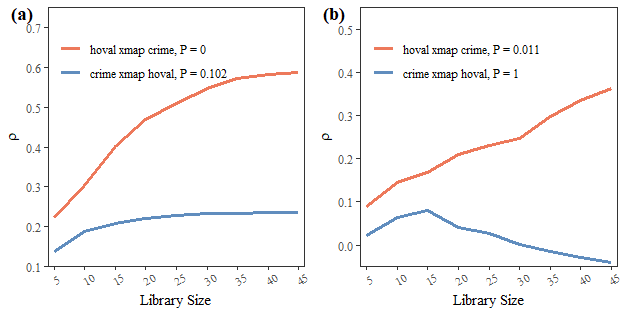
Example of spatial raster data
Load the spEDM package and simulate raster data with a
cyclic interaction structure \(x \rightarrow y
\rightarrow z \rightarrow x\):
if (!requireNamespace("fields")) install.packages("fields")
## Loading required namespace: fields
if (!requireNamespace("MASS")) install.packages("MASS")

sim_trispecies = \(nx,ny,seed = 123){
  grid = expand.grid(seq(0, 10, length.out = nx),
                     seq(0, 10, length.out = ny))
  cov.fun = \(d, range = 1.5, sill = 1) sill * exp(-d/range)
  dist.mat = fields::rdist(grid)
  cov.mat = cov.fun(dist.mat, range = 1.5, sill = 1)
  set.seed(seed)
  res = replicate(3, {
    MASS::mvrnorm(1, rep(0, nrow(grid)), cov.mat) |>
      #pmax(0) |>
      sdsfun::normalize_vector(0,1) |>
      matrix(nrow = nx, ncol = ny) |>
      terra::rast()
  }, simplify = FALSE)
  terra::rast(res)
}

species = sim_trispecies(20,20, seed = 42)
names(species) = c("x","y","z")

sim = spEDM::slm(species, x = "x", y = "y", z = "z", k = 4,
                 step = 15, transient = 1, threshold = Inf,
                 aggregate_fn = \(.x) .x[length(.x)],
                 alpha_x = 0.75, alpha_y = 0.78, alpha_z = 0.76,
                 beta_xy = 0.35, beta_xz = 0, beta_yx = 0, beta_yz = 0.35,
                 beta_zx = 0.35, beta_zy = 0)

terra::values(species[["x"]]) = sim$x
terra::values(species[["y"]]) = sim$y
terra::values(species[["z"]]) = sim$z
species
## class       : SpatRaster
## size        : 20, 20, 3  (nrow, ncol, nlyr)
## resolution  : 1, 1  (x, y)
## extent      : 0, 20, 0, 20  (xmin, xmax, ymin, ymax)
## coord. ref. :
## source(s)   : memory
## names       :        x,        y,        z
## min values  : 0.591053, 0.599642, 0.525905
## max values  : 0.881712, 0.864149, 0.876286
Determine minimum embedding dimensions:
spEDM::fnn(species, "x")
## [fnn] Input E values exceeding max embeddable dimension were truncated, and values < 2 were clamped to 2.
## [fnn] Max embedding dimension E_max is auto-computed, with results returned for dimensions 1 through E_max.
## [fnn] Output 'E:i' (where i = 1 to E_max-1) corresponds to the comparison between dimension i and i+1.
##    E:1    E:2    E:3    E:4    E:5    E:6    E:7    E:8    E:9
## 0.8225 0.1750 0.0125 0.0000 0.0000 0.0000 0.0000 0.0000 0.0000
spEDM::fnn(species, "y")
## [fnn] Input E values exceeding max embeddable dimension were truncated, and values < 2 were clamped to 2.
## [fnn] Max embedding dimension E_max is auto-computed, with results returned for dimensions 1 through E_max.
## [fnn] Output 'E:i' (where i = 1 to E_max-1) corresponds to the comparison between dimension i and i+1.
##    E:1    E:2    E:3    E:4    E:5    E:6    E:7    E:8    E:9
## 0.8625 0.1900 0.0250 0.0000 0.0000 0.0000 0.0000 0.0000 0.0000
spEDM::fnn(species, "z")
## [fnn] Input E values exceeding max embeddable dimension were truncated, and values < 2 were clamped to 2.
## [fnn] Max embedding dimension E_max is auto-computed, with results returned for dimensions 1 through E_max.
## [fnn] Output 'E:i' (where i = 1 to E_max-1) corresponds to the comparison between dimension i and i+1.
##  E:1  E:2  E:3  E:4  E:5  E:6  E:7  E:8  E:9
## 0.87 0.13 0.00 0.00 0.00 0.00 0.00 0.00 0.00
Self prediction for parameter turning:
s1 = spEDM::simplex(species, "x", "x", E = 4:10, k = 12, tau = 1)
s2 = spEDM::simplex(species, "y", "y", E = 4:10, k = 12, tau = 1)
s3 = spEDM::simplex(species, "z", "z", E = 4:10, k = 12, tau = 1)
list(s1,s2,s3)
## [[1]]
## The suggested E,k,tau for variable x is 4, 12 and 1
##
## [[2]]
## The suggested E,k,tau for variable y is 4, 12 and 1
##
## [[3]]
## The suggested E,k,tau for variable z is 4, 12 and 1
Investigate the causation between x and z, with y as control variables:
xz = spEDM::scpcm(species, "x", "z", "y", E = 4, k = 12,
                  libsizes = matrix(seq(50,400,50), ncol = 1),
                  progressbar = FALSE)
xz
## --------------------------------------
## ***partial cross mapping prediction***
## --------------------------------------
##   libsizes      x->z      z->x
## 1       50 0.4736296 0.4933618
## 2      100 0.5212682 0.5577015
## 3      150 0.5581261 0.6211235
## 4      200 0.5729440 0.6705097
## 5      250 0.5593462 0.6971944
## 6      300 0.5321784 0.7161755
## 7      350 0.5133112 0.7527040
## 8      400 0.5014350 0.7640829
##
## ------------------------------
## ***cross mapping prediction***
## ------------------------------
##   libsizes      x->z      z->x
## 1       50 0.6138023 0.6273096
## 2      100 0.6427045 0.6735237
## 3      150 0.6758891 0.7162489
## 4      200 0.7067327 0.7559218
## 5      250 0.7282486 0.7846552
## 6      300 0.7402653 0.8008604
## 7      350 0.7495153 0.8101575
## 8      400 0.7554037 0.8147119
Visualize the result:
fig2a = plot(xz,partial = FALSE,ylimits = c(0.6,0.95))
fig2b = plot(xz,partial = TRUE,ylimits = c(0.45,0.95))
fig2 = cowplot::plot_grid(fig2a,fig2b,ncol = 2,label_fontfamily = 'serif',
                          labels = paste0('(',letters[1:2],')'))
fig2